Showing posts with label grammar. Show all posts

5.21.2014

The Great Adverb Mystery of 2010

Friends,

I took about 5 months off from writing Tangents. Many of you may have come to the horrifying, devastating (read: having no visible or felt effect) conclusion that this blog had petered out and died. Alas! No! 

I got married, guys, and while I've still found plenty of ways to waste time, for a while I let go of this blog to figure out my new life. Now that I've done so (read: summer is here), Tangent Space(s) is back.

And we return with a story I meant to blog about a few years ago...

Answering rather brilliantly
"if I do say so myself," which is a weird phrase because it always follows something the speaker did indeed just say

Several years ago, one of my best friends was getting married. Being much cooler and more adventurous than, say, I am, he decided to have his bachelor party in New York City. (Who wants to cavort around Times Square, Broadway, and Central Park when you can comfortably play games in an apartment? But that's not the point of this story.) I wasn't able to make the trip to the Big Apple, so I was home that night, going to sleep at a somewhat reasonable time.

At approximately 3:45am, several hours after my somewhat reasonable bedtime, my phone rang. Now, reader, you may or may not know me well, but either way please believe me when I tell you that when I wake up unexpectedly, I do so as an alternate bear-zombie version of myself. I don't know who or where I am, I paw the air while growling, and my face displays the vacant, heartless stare of the undead.

So it was that Zombie Bear (not a bad Smash Up deck, I bet) Jon answered his phone in the middle of the night, wondering who in the world would call at such an hour. The answer, of course, was a member of my friend's bachelor party; and while the caller's ID will remain secret, it's a safe bet he resembles an iconic 80s teen movie star. The point is, I answered the phone with about 10% brainpower.

"Jon!!!" the caller said, "You're smart!" (At this point I started waking up to flash my modest smile, graciously accepting the compliment.) "We were trying to think of adverbs that don't end in -ly. Can you think of any?!"

Now, there are like 3 things in the world that merit a call at 3:45am:

1. A medical emergency to a loved one
2. The death of a loved one
3. A wake-up call to prepare for a 6am flight

A fun little word challenge is obviously right on the bubble, but I don't think it makes the cut...

At any rate, I think deep down I appreciated the chance to play a role in the bachelor party, so I used what little brain power I had access to and got to work. My first thought was the one that proved to be key, and that was-- remember what an adverb is. It's a word that modifies a verb or adjective (or another adverb, but it was way too early to get that close to adverb-ception). The first category, adverb that modifies verb, isn't very helpful as all the ones that come to mind off the top of one's zombie bear head end in -ly: quickly, furtively, secretly, stealthily (we are apparently modifying the verbs of spies and pickpockets).

But the second function of adverbs! Yes! Which adverbs most commonly modify adjectives? Many of them work, e.g. quite, rather, very, super, and so. I rattled these off, along with the only one I could think of from the first category, "well."

And so, after an episode likely not remembered by the actual attendees of the event, I drifted back to sleep considering myself a Bachelor Party Hero...

What's in an adverb?
other than the letters L and Y

- Can you think of more adverbs that don't end in -ly?
- What's your favorite adverb?

Jon
Not sure if a photo credit is needed for some janky piece of clipart. If so: digilearner.com


1.09.2014

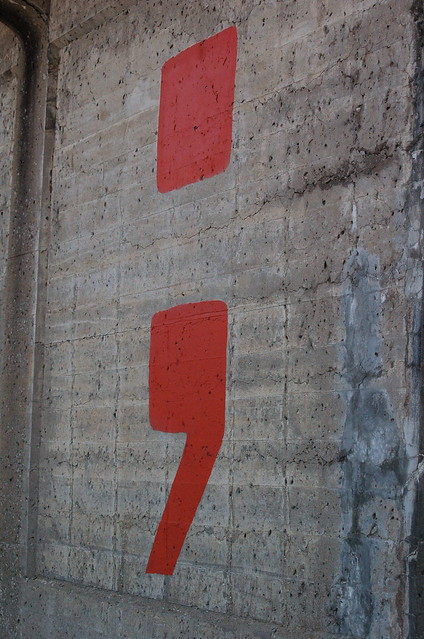
Guest Post: The Semicolon

(Today's post, and hopefully what kicks Tangent Space(s) back into high gear, is from my awesome friend Jeromie up in the Great White North. The link to his blog can be found at the end of the post.)

Semicolon
Semicolons; they stand united.
Photo Credit: 
ilovememphis via Compfight cc

Remember those basic standards tests we had to take back in high school? The ones you needed to pass in order to graduate? At our school we had to meet with our English teacher one-on-one before we could take the writing test.

As I sat down, she quickly assured me that I had nothing to worry about. In fact, she even challenged me to try a few new writing techniques just to spice things up a bit (that's when I knew for a fact teachers really don't read students' papers). Her exact words:

'You should try throwing in a semicolon or two; they're an easy way to bump up your score.'

I took her advice, and ended up scoring a 5 out of 4. You read that right - apparently the writing test people should spend more time with the math test people. I think it was supposed to be a scale of 1 to 4, then 4's were broken down and scaled from 4 to 7. Maybe to make the 2's and 3's not feel as bad as they would if it were 2 out of 7 or 3 out of 7? Who knows...

She had created a monster. I tend to use them everywhere now; not quite as often as the hyphen, but still more than any human should. And now I have an even bigger confession to make - I never actually took the time to learn how to properly use the semicolon!

If you know, please don't share. I'd much rather go on living in my own happy little world.

Instead of learning the rules, I decided to make my own little gradient for connecting phrases in my writing. It goes something like this:

And
Two phrases, one uninterrupted thought. 'She slapped him and walked furiously out the door.'  

Comma
Two phrases, one thought with a slight pause in the middle. 'Reaching the sidwalk, she paused and considered going back for her world-class record collection.'  

Hyphen
Two thoughts, closely connected. Often an effect-cause relationship. 'She decided to forget about them - they would remind her too much of him anyway.'  

Semicolon
Two thoughts that could stand on their own as two sentences. Implies slightly more intimacy than a period. Also implies the writer has a better-than-thou mentality. 'The brake lights disappeared into the distance; he was going to miss her something fierce.'  

So there you have it - my made up rules for writing.


Which grammar rules do you follow religiously? Which do you avoid like the plague? Are any of them rules that you made up yourself?

8.08.2011

August 2011 Grammar Tip

Homophones will get you every time.

It almost isn't your fault, right?  I mean, the words sound exactly the same, and for you to spell the correct word, you'd have to do all kinds of extra steps.  Study the context, contrast definitions, match spellings to meanings, and pick the correct one.  Who can be expected to endure 4 mental processes in a pinch?!

I expect you to.  All of literate humanity should be held to this level of communicative passability.

And while there are so many pitfalls we could address today (there, their, they're, whose, who's, Jon, John), let's go straight for the jugular.


It's and Its

I'm just going to offer you one straightforward test you can apply each time you attempt to use ITS or IT'S.  Noting that the apostrophe in IT'S stands for the letter i ("IT IS"), just ask yourself -- does this word stand for "it is"?

It's that simple, every time.  So if you're typing a slide for a song at church and see:

I'm coming back to the heart of worship
And its all about You, all about You, Jesus

You just ask yourself two questions:

1. Is this song retired into the worship hall of fame, never to be played again?
2. Does the its/it's word stand for "it is"?

In this anecdotal example, the song is, in fact, retired, and so the correct move would be to delete those slides and insist on a new worship song that hasn't been played 300 million times in our lifetime.  But, for the sake of grammar, let's move to question 2.

Replacing "it is" for "its", we get "It is all about you, Jesus."  Yes!  That's what we're trying to say.  And so, we know we need the apostrophe to represent that extra letter i; we go with IT'S.

One more example.  Let's say you're writing a children's book and you've just penned, "The cyborg blasted it's laser."  Firstly, that's too scary and futuristic for a kid's book.  Secondly, applying our ITS/IT'S Test, we get--

"The cyborg fired it is laser."

As this clearly makes no sense, we do not have an extra letter i, and thus do not need an apostrophe.  So "its" it is.  (<-- Yeah.)


It's its or it's, is it?

Thoughts, questions, stories, ideas for future grammar tips?

Jon

7.06.2011

July 2011 Grammar Tip

Friends,
It's a new month.  After just 6 days, July 2011 is already replete with grammatical errors.  Everywhere you turn, there's a misused apostrophe or a dangling modifier.  But, as with most nationwide endemic problems, we can't win the war in a day.  And so, at the clip of one tip per month, Tangent Space(s) continues to do its part...


Using the correct pronoun

Few ideas seem as polarizing as "political correctness."  I won't go into that now.  I only bring it up because political correctness is in some sense the reason we use an incorrect pronoun when a subject's gender is unknown.

I'll give an example sentence, and take you on a historical journey of how people of different eras might have chosen their pronouns:

I think a person should try to befriend [possessive pronoun] neighbors.

1. The good old days: he/him/his

(I don't actually know if these days were good, but they're somewhat old.)  It was once universally accepted to use the masculine in the case of an unknown gender, so that whether a sentence was about an athlete, doctor, homeless person, or convicted felon, we just went with the masculine pronoun and made a mental note that we didn't really know the sex of the person.

The above sentence, then, would suggest that a person should befriend his neighbors.

2. The unwieldy alternative: he or she / him or her / his or her

With the advent of widespread political correctness, this new bulky option became the norm.  The obvious drawback is that it's triple the word count.  This isn't terrible when you need to use it once, but if you have 4 or 5 unknown-gender situations in a row in speech or writing, these added words are agonizingly cumbersome.

Back to neighbors: a person should befriend his or her neighbors.

3. The current answer to the bulky "his or her": mixing up "her" and "his"

In modern books, authors refuse to pay the price of repeated "his or her"s.  So the current trend is to get a good mix of the sexes in the pronouns.  Usually a male author will use "her" the first couple times -- just to ensure, presumably, that he's not sexist -- then go to an alternating system of "his" and "her".

Ex. A person should try to befriend her neighbors... A doctor must cultivate healthy relationships with her nurses... A politician must listen closely to his constituents... her... his... her... his...

4. The grating, terribly incorrect solution in speech: they/them/their

And this, English-speaking friends, is why I wrote this grammar tip.  In casual speech, people will handle the unknown-gender problem by using a plural pronoun, since plurals aren't gender-specific.  Unfortunately for the many people who do this, it sounds (to at least a few of us) like fingernails on a chalkboard.

Returning to the example of Mr. Rogers... A person should try to befriend their neighbors.

Do you see how catastrophic that is?!?  "Person" is singular.  "Their" is plural.  "I" am irate.


I leave you with no hope

Just kidding.  There's always hope.  But in this dilemma, I don't know what to tell you.  Here goes:  When speaking, just say "his or her", or pick a winner.  When writing something serious, go with option 3 above.  When writing on Tangent Space(s) or an equivalently silly project, go with shis every time.

Thoughts?  Questions?  Ideas for future grammar tips?

Jon

6.15.2011

June 2011 Grammar Tip

Thanks to everyone who responded to last month's tip and gave ideas for future months.  This month's grammar tip goes out to apostrophes everywhere.


The right and wrong ways to use an apostrophe

There are 3 (and only 3) correct uses for apostrophes in the English language.  They are...

1. Possession
Ex.:
This is Jon's calculator.
This is Jon's extended edition DVD of The Two Towers.
No, she is not Jon's girlfriend.

2. Contraction
Ex.:
It's not like I'd betray those who've misused apostrophes, because I'm sure I've done it (haven't we all?), and if I don't stay careful, I'll hurt someone and he'll say he'd never do a thing like that and it wasn't his fault and it isn't my business and this won't be the last I hear from him.

3. Outlandish first names
Ex.:
Da'Quan
D'Sean
D'Mario
Mone't
D'asia
(These were ones I found quickly on google. Sadly, D'Luigi returned no results.)

What you can't do with an apostrophe is pluralize common words.  So if you see a sign in a grocery store that says "Banana's" or "Apple's", you know you're not in a grammar store.

I will now say something that, if you're a seasoned grammarian, might blow your mind.  According to p. 985 of Greenbaum and Svartvik's A Comprehensive Grammar of the English Language (according to wikipedia, of course), it is acceptable to use an apostrophe to pluralize written items that aren't actual English words.

Thus, it would be grammatically ok to write that such-and-such global war happened in the 1940's or that you learned your ABC's.

[There's no compelling reason for me to argue for this pluralization opinion, but I thought it might shock a few of my highbrow friends, and highbrow people need to chill out.  And I do realize that, grammatically, I'm typically the highest brow.]


Thanks for reading!

As always, I'm accepting feedback, questions, praise, disagreement, relevant prose or poetry, and ideas for future posts in the Comments section.

Jon

5.10.2011

May 2011 Grammar Tip

I have decided that Tangent Space(s), by merely providing entertainment to its small but loyal group of readers, doesn't make much of an impact on the world.  I am an impact junkie, so this is unacceptable.  Thus, I introduce to you a new feature: grammar tip of the month.  We will be improving our communication, one act of grammar policing at a time.

In case you missed the one from March -- and you probably did since it only occurred as a tweet -- something piques (not peaks) your curiosity.  What I find interesting about this is that there is some false intuition that lends itself to "peaks": if there were a chart of your curiosity level over time, then something intriguing would perhaps "peak" it.  But alas, there is no such chart (at least not for me), and "piques" is correct.

There was no grammar tip for April, since I just decided to implement this plan today.  But had there been, it probably would have been about how you need to replace splicing commas with semicolons (or add more words).  This would have been hypocrisy at its finest, since I'm a prolific comma splicer. (And yet, notice how the word "since" makes that comma appropriate... but picture the horror of that sentence without "since"!)


Grammar tip of the month

The word mischievous is a three-syllable word pronounced MISS-chuh-vus.

Yeah, I sense the wheels are turning.  It's not miss-CHEE-vee-us.  That is always wrong.  If you look closely at the word (and where the second i is located), I'm sure you'll realize how untenable that popular but incorrect pronunciation is.


Join the Tangent Space(s) Grammar Police Academy

Please send me ideas for future posts or future grammar tips, volunteer to guest- or co-author, etc.


Jon